02 Why this exists
The gap between a brief and a formula
Turning a brief into a starting formula takes about an hour of arithmetic. Volatility has to work out and the concentration has to land before you can weigh anything.
Fragrance Engine does that hour. Describe a scent and it composes a starting formula you can iterate on.
The same brief gives the same formula
The composition is arithmetic: concentration, descriptor weights, volatility filtering, and accord scaffolding. Run the same brief twice and you get the same formula, down to the decimal.
The language model has a narrow job. It reads your intent, and it drafts a scent story and a name if you want them. It is never asked what goes in the bottle.
Pillar 01
Real materials
A curated catalog of naturals and aroma chemicals, each carrying descriptor profiles, real physical data, and per-supplier lot overrides.
Pillar 02
The math
Mass-weighted density for every lab sheet, physics-backed volatility model (Calkin & Jellinek's BP-MW framework), and percentages that add to 100, or an inline UNBALANCED flag when they don't.
Pillar 03
The material page
Every material carries its physical data, its price and the formulas you have used it in, laid out to be read at the bench.
From a sentence to a lab sheet
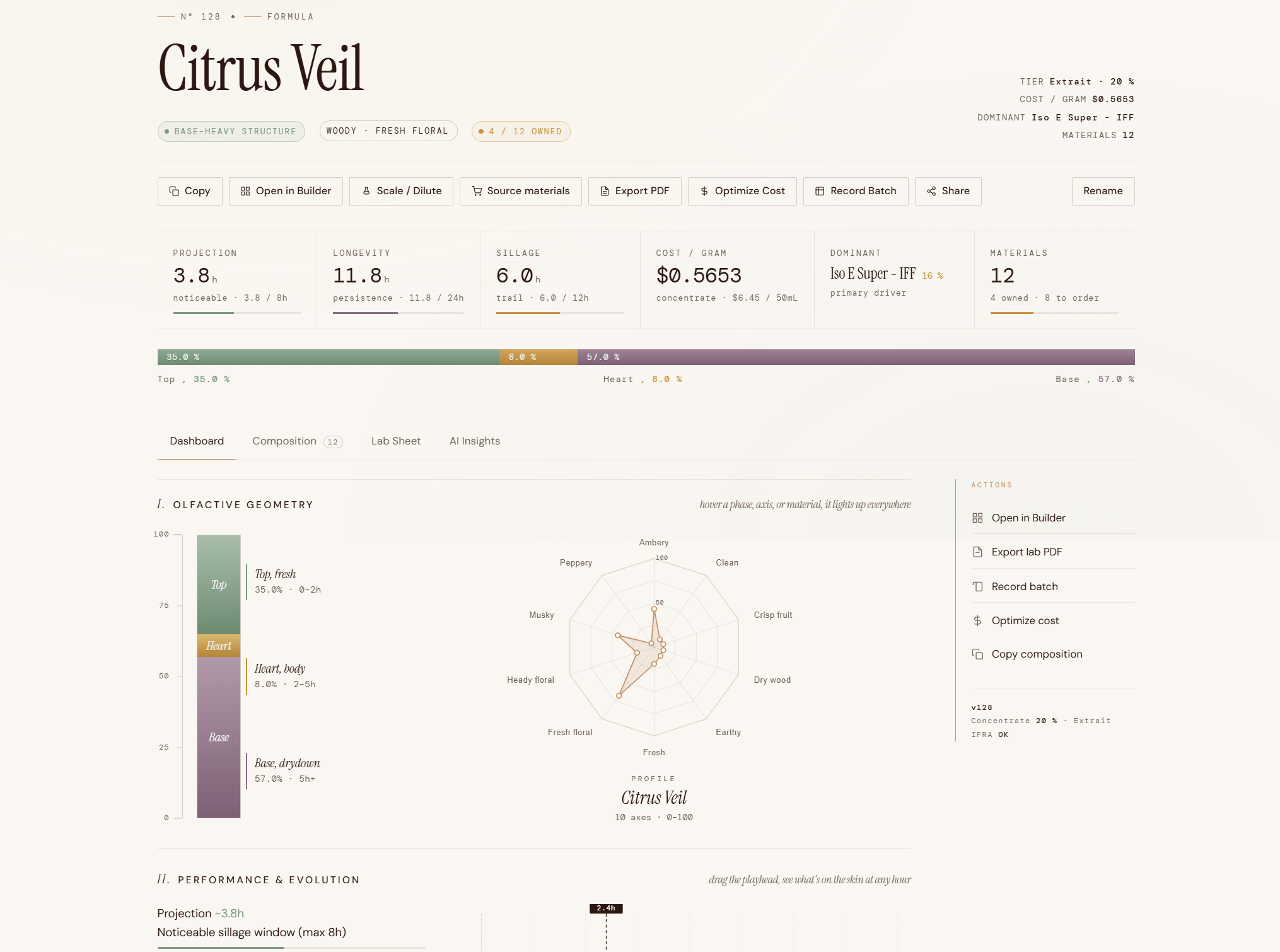
Describe a scent in plain words. The engine composes a formula you can weigh on a scale, and shows the pyramid and the working behind every gram.
What is working now
Brief to formula
Write a sentence and get a top, heart and base built from real materials at exact percentages, ready to edit.
Accords you build once
Compose a sub-blend, save it as an accord, then drop it into any later formula as one ingredient.
Lab sheets that weigh true
Mass-weighted density turns mL into grams correctly at any batch size, so the sheet you print is the sheet you weigh.
Evaporation from physics
Boiling point and molecular weight decide how a fragrance projects and how long it lasts.
The catalog, your way
Read the 311-material library as a dense register, an olfactive scatter map, or editorial cards, whichever way you think.
Sourcing on the formula
Every material carries a buy link, on both plans. Studio adds a cost optimizer that swaps in something cheaper or easier to source while the accord still holds, and it keeps the supplier prices updating from real listings.
Publish to the Formulary
Browse a community library of accord editions and take any of them into your workspace. Publishing your own is a Studio feature, and it puts your work in front of other perfumers.
Who makes this
Fragrance Engine is built and run by one person, a chemical engineering student in New York. The physics comes from that: boiling points and molecular weights are how an engineer thinks about evaporation. The code, the curated catalog, the copy and the support inbox are the same pair of hands, so when you write in you are talking to the person who can fix it.
A one-person product cuts both ways, so the honest version is in writing. The promises about your work, including what happens if this project ever winds down, live on your formulas are yours. The methods behind every number are documented on the methods page, and the public changelog shows the shipping cadence rather than asking you to take it on faith.
Questions or requests? [email protected]