How the engine builds a formula
The same brief always produces the same formula. The percentages come from arithmetic over measured physical data, so you can run it again in six months and weigh out the same liquid.
Describe
Tell it what you're after in plain words, or dial in descriptors and an archetype yourself.
Draft
The engine composes a balanced formula from real materials, with a full top-to-base structure you can see.
Refine
Edit it gram by gram, and the pyramid, the projection, the cost, and the lab math all recalculate as you work.
Source
Every material carries a buy link and a catalog price. Studio keeps the supplier prices updating from real listings, and its cost optimizer can swap in a cheaper material and rebalance so the accord still holds.
Export
Print a lab-ready sheet with exact masses for any batch size, ready for the bench or the manufacturer.
What the engine actually does
Four things happen between your brief and the percentages on the finished lab sheet. They run in order, and each one is described below.
Deterministic engine
A 15-stage pipeline turns scent descriptors into balanced formulas. Every stage is arithmetic you can follow. Run it twice with the same brief and you get the same formula twice, to the percentage.
Physics-backed evaporation
Every material's behavior is computed from measured molecular data, chiefly boiling point and molecular weight, using the framework labs use to rank volatility.
Density-aware lab math
Percentages are by mass, but you measure by volume. The engine computes the mass-weighted density of every formula and converts mL to grams correctly, so your scale matches your spec.
Every formula, read back to you
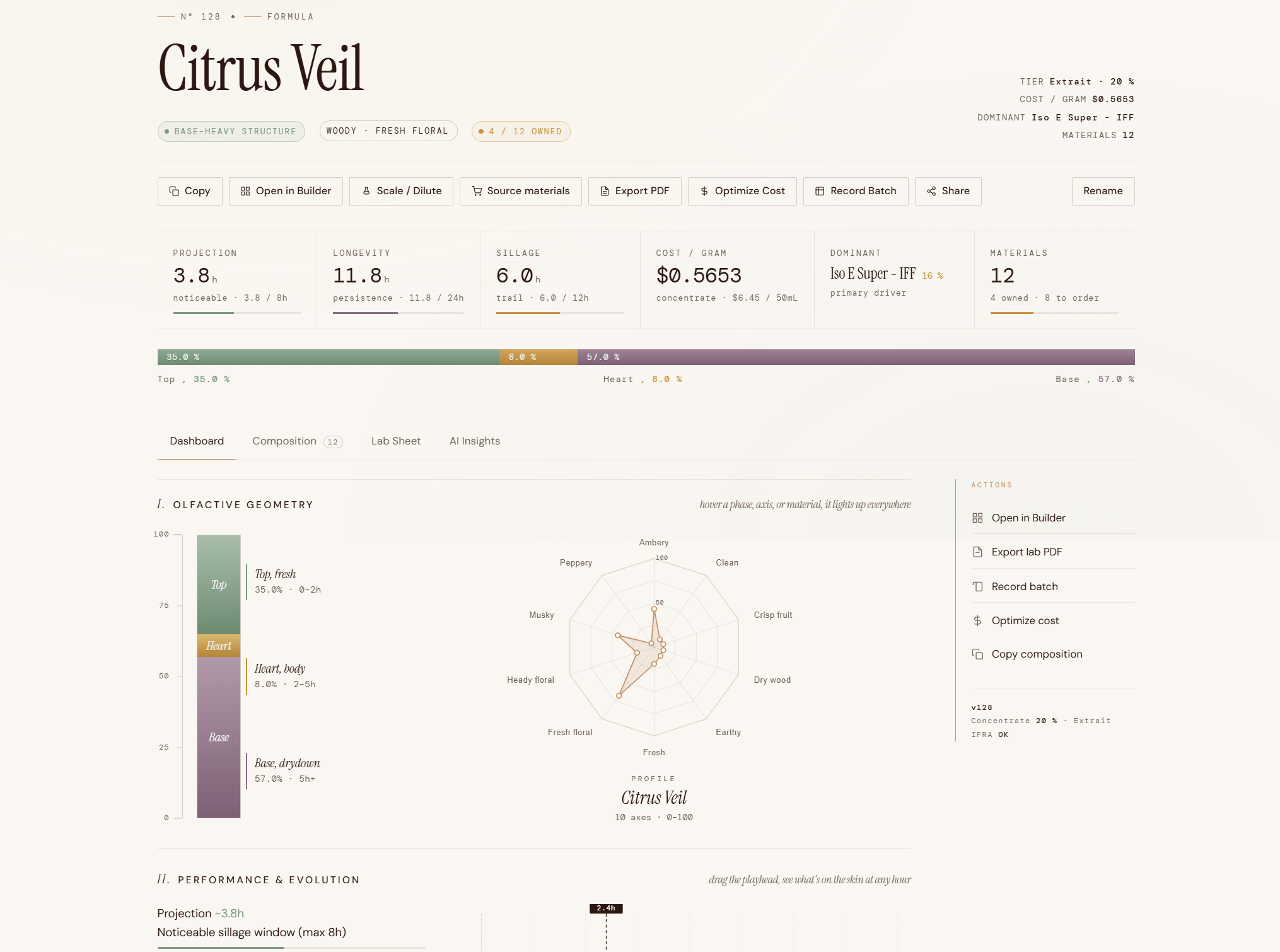
The moment a formula exists, the engine reads it back: the pyramid, projection, longevity, structure and cost. That is the bench analysis a perfumer would otherwise work out by hand, on every formula you have.
Why it repeats exactly
The pipeline is deterministic: descriptor weights → semantic match against the materials library → physics-derived role assignment → constraint solver → normalized percentages. Nothing in that chain is sampled, so the same inputs give the same outputs every time.
That means you can save a formula, hand it to a chemist or contract manufacturer, and reproduce it weeks later without explaining a prompt.
"If you can't run the formula twice and get the same liquid, it's not a formula. It's a sketch."
Where the numbers come from
Whether a material reads as a top note (bright, fleeting) or a base note (warm, persistent) follows from its boiling point and molecular weight. The engine reads both values for every material in your library and computes a volatility index, a number between 0 (a heavy resin) and 1 (a flash-off citrus), read from two curated properties every catalog material carries.
The 60/40 BP-vs-MW weighting comes from Calkin & Jellinek's "Perfumery: Practice and Principles", the same textbook taught at Givaudan's perfumery school. Boiling point is the dominant predictor of room-temperature evaporation rate, with molecular weight as a correction.
From that single volatility number, the engine derives every other behavioral metric: projection (how far it throws on a first spray), longevity (how long it lingers on skin), sillage (the trail you leave behind). Each one is an equation written out in the engine reference, so you can check it.
Mass-weighted density
Most online dilution calculators pretend 1 mL = 1 g. It is not. A citrus-heavy top is closer to 0.88 g/mL. A vanillin-laden base can reach 1.05 g/mL. At 10 mL of concentrate, that's a 1.7 g difference between what your scale reads and what your spec sheet says.
Standard physical chemistry. The engine reads each material's actual density from a curated catalog, computes the mix density for your formula, and prints real per-material gram amounts on the lab sheet. When the mix density deviates from water by more than 0.05 g/mL, a flag appears so you know the volume and weight figures disagree.
The two data sources
Per-material physical data comes from two sources. Where they disagree, a documented per-field priority decides which one is used.
PubChem (NIH)
The U.S. National Library of Medicine's reference database. Molecular weight, boiling point, vapor pressure and logP, either lab-measured or computed against a peer-reviewed standard.
The Good Scents Company
The de-facto industry catalog of fragrance materials: density, recommended use levels, scent descriptions, and supplier-verified physical data for the naturals and captives PubChem doesn't cover.
For your own laboratory inventory, you can also save lot-specific overrides, a Rose Otto from one supplier may measure differently from another. The engine prefers your measured values over the catalog defaults when it computes a lab sheet for that lot.
What a formula costs to make
Every formula carries a cost per gram, and each material links out to where you can buy it, so a formula on screen doubles as a shopping list for the bench. The free plan reads the catalog price. Studio pulls live prices from real supplier listings wherever we have them.
The cost optimizer goes further: it finds descriptor-matched substitutions that bring the price down while the olfactive shape barely moves.
What these estimates are worth
Nothing here has been measured in a lab
Real fragrance performance depends on skin chemistry, ambient temperature, humidity, application method, concentration, oxidative aging of ingredients, and how the wearer's clothes interact with the alcohol carrier. The engine's projection, longevity and sillage hours are for comparing two formulas against each other. They will not predict an exact number on a specific person. Where lab data exists for real fragrances (Aventus, Sauvage), the estimates land within roughly ±1.5 hours on longevity and within one bracket on projection.
Ready to compose?
Start a 7-day trialThe full engine and the real 311-material catalog, free to try for a week.